Book: Lolita
Lens: Psychoanalytical
"But let us be prim and civilized. Humbert Humbert tried hard to be
good. Really and truly, he did. He had the utmost respect for ordinary
children, with their purity and vulnerability, and under no circumstances
would he have interfered with the innocence of a child, if there was the
least risk of a row. But how his heart beat when, among the innocent throng,
he espied a demon child, "enfant charmante et fourbe," dim eyes,
bright lips, ten years in jail if you only show her you are looking at her.
So life went. Humbert was perfectly capable of intercourse with Eve, but it
was Lilith he longed for. The bud-stage of breast development appears early
(10.7 years) in the sequence of somatic changes accompanying pubescence. And
the next maturational item available is the first appearance of pigmented
pubic hair (11.2 years). My little cup brims with tiddles."
 |
Alfred Drury, R.A., 1856 - 1944
|
 |
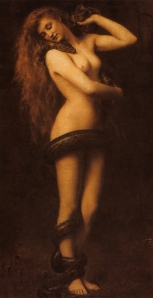
| Lilith by John Collier (1892) |
In the passage above, Humbert explains that he did try to behave as others should, to be responsible enough to not be attracted to young girls as to not take advantage of them. In the passage, he explains that it is not his fault, but the child's responsibility to not attract him in the first place. He states that a demon child, a "
enfant charmante et fourbe" ( a charming and deceitful child ) will always catch his eye and that we would never interfere with a child's "pureness". The biblical allusion to Eve and Lilith was quite interesting, assuming any woman his age would be Eve, and Lilith was the young girls he was attracted to. There are many explanations about Lilith's part in the story of Adam and Eve, that she was the original Eve, that she refused to oblige to male dominance and ran off into the red sea. One variation of the Lilith's story that would make sense to compare is that she had "committed adultery with Satan" (
source) and turned into a succubus, a demon that seduces men, after refusing to submit Adam. After that, God created Eve as a replacement to satisfy Adam. We know that Humbert thinks very highly of himself, as earlier in the book, he states that he "at the snap his fingers" (15) could have any
adult female he wanted. This would be why he referenced himself to Adam, who was given Eve right after he was denied Lilith. What's truly frightening about this allusion is the comparison of the young girls to Lilith. With this comparison, this solidifies his mentality that he is not responsible for his attraction to these young girls that are not "pure" or "innocent", that this is caused because they are as he explicitly states, "demons" or more specifically "succubi" that seduce him. This mentality is a common one that sexual predators have, that they truly believe their actions are justified because the responsibility is not theirs to not be a sexual predator, that the responsibility falls onto the victim to not be a target.

No comments:
Post a Comment