Friday, June 5, 2015

blog post #8: final reflection


Lolita is a novel about a story told through a book written by Humbert Humbert while in prison, about his life and events around his childhood, his relationships, and his relationship with Lolita. Humbert's attraction to young girls originates from a childhood trauma, losing his first love, Annabelle, to a fatal sickness. He had never gotten over Annabelle, and felt attracted to girls with similar features, of that of a child. Decades after her death, Humbert had moved to America, where he met Lolita after moving in as a tenant with her mother. He marries Lolita's mother in order to stay close to Lolita, his new "Annabelle". After an accident takes Lolita's mother, Humbert spends time around the United States with his new relationship with Lolita. The dynamic of power is what brought Lolita to stay with Humbert until she leaves with another older man. Humbert spends years tracking down the one who was "stolen" from him, and eventually finds her, pregnant,  and without the man who had taken her and left her to end up murdering him, and being arrested.

My lens, psychoanalytical, pushed me to step back from my own views, and look through the views of the teller of the story, Humbert Humbert. My understanding of the lens did not change what I thought of the lens  itself, but did change how I had perceived the novel. Although I will never sympathize with Humbert's actions, I do understand why they were committed.
If I had chosen another lens, I do not believe I would take as much time to assess why Humbert was doing what he was doing, as I would have to what he was a doing and focus on punishment. I do not believe I missed things from the novel, as my focus, psychoanalytical, is what I believe captures most from the book than all the other lenses.
I believe this because of what was said in the beginning of the book,  the "people of the jury",  the audience that will read this book through the eyes of Humbert, and analyze and assess his point of view with their own, which is what the book, and the novel itself, is intended for. This lens might not be perfect for other books, and the downsides would be that I would focus too much on the why of the events rather than the events themselves. Again, my beliefs had not changed towards the behaviors of Humbert, or any person who Humbert could potentially symbolize, but I do know that actions are not caused on their own. I do believe that Humbert believed he wasn't as guilty as many would think of him without knowing the cause of his actions, which is why he wrote this book in prison, but I do not excuse his actions. 

blog post #7: responding and reflecting

"I may have lost contact with reality for a second or two--oh, nothing of the I-just-blacked-out sort that your common criminal enacts; on the contrary, I want to stress the fact that I was responsible for every shed drop of his bubbleblood; but a kind of momentary shift occurred as if I were in the connubial bedroom, and Charlotte were sick in bed. Quilty was a very sick man. I held one of his slippers instead of the pistol--I was sitting on the pistol. Then I made myself a little more comfortable in the chair near the bed, and consulted my wrist watch. The crystal was gone but it ticked.The whole sad business had taken more than an hour. He was quiet at last. Far from feeling any relief, a burden even weightier than the one I had hoped to get rid of was with me, upon me, over me. I could not bring myself to touch him in order to make sure he was really dead. He looked it: a quarter of his face gone, and two flies beside themselves with a dawning sense of unbelievable luck. My hands were hardly in better condition than his. I washed up as best I could in the adjacent bathroom. Now I could leave. As I emerged on the landing, I was amazed to discover that a vivacious buzz I had just been dismissing as a mere singing in my ears was really a medley of voices and radio music coming from the downstairs,"(304).

Humbert has just murdered Quilty, who had "taken" Lolita away from him. Humbert had shot him in cold blood after a short struggle between the two. What was very disturbing is that after shooting him, Humbert was disappointed that he did not feel any relief that he was hoping he would have felt. He even tried to make himself more comfortable in the same room. He sees that a quarter of his face has been blasted off, yet Humbert still makes a mental note of not wanting to check if he was dead. Considering Humbert pursued relations with a young girl, this would lead me to believe that he was mentally ill, and his emotionless state after killing another man in cold blood, confirms my thought.


blog post #6: responding and reflecting

I can't read any scenes with Lolita without anger. Every page to which she is seen as "promiscuous" or a "tease" I think, she is only twelve years old. A child.  A child that is objectified by this man. A child, a child, a child. You cannot describe her any different. The thoughts and analyzations of my fellow classmates also struck me the wrong way. Many describe Lolita as a sexual deviant, or you could also say nymphet, as Humbert describes these girls. Again, this story is being told through the eyes of a man that is attracted to children. He is describing this girl as if she was an adult, and you have to remind yourself of the perspective you are reading from. Reading through the psychoanalytical lens,  I tell myself this, and wonder if this was the aim of Vladimir Nabokov. To see how the readers will perceive Humbert and his perspective. To see if they take his perspective as fact, or remind themselves of his bias. In the beginning of the book he states that Lolita "seduced" him, but this is only due to his attraction and sexualization of young girls in the first place so he takes advantage of her attraction to him. I want to further explain the age and power dynamic I mentioned in an earlier blog post. Children cannot consent due to their age because they are unable to understand their certain situations and decisions put upon them. There is an imbalance of power because the adult, in this case Humbert Humbert, can easily put thoughts into a child's head, about what is right and what is wrong because of the authority they have. Lolita continues her behavior because Humbert allowed her to, he let her believe that she is consenting, that the relationship is okay.

blog post #5: responding and reflecting

Humbert Humbert is an extremely disturbed man. Reading Lolita through the psychoanalytical lens had made me look for specific traits in Humberts character. Throughout the beginning chapters of his story, Humbert speaks about his life, and his encounters with the women in his life. Many of the 'women' he speaks about are not women at all, but young girls. Young innocent children, his targets, potential victims, and his victims.

However, reading through the psychoanalytical lens makes me realize that those that I identify as victims to this horrible man, are seen through a different light in his eyes. He does not see these children as victims. When he speaks of Monique, the "nymphet" he speaks of his attraction to her, of how she made him feel specifically because of how she looked. He does not see her mentality, her as a victim, her feelings. He just sees what he wants to see. He does however mention earlier that he would never mess with a child's "innocence", and that makes me think, does he believe he is not doing wrong considering he does have some sort of 'moral'?

His objectification of young girls only goes as far as pursuing sexual relations when the younger party willingly goes along with it. (Monique, and eventually Lolita).  I use the word 'willingly' very loosely here because of the age and power dynamic that is present in these relationships. Especially with Monique, due to her being a, possibly underage, prostitute.  What are the psychological effects of her doing this job, and what are the reasons behind her pursuing this job in the first place at such a young age? We don't get to know this, because again, we are reading through Humbert Humbert's eyes. He doesn't consider these thoughts, because of his attraction, and because he see's her doing this job as her full consent.

Monday, May 18, 2015

blog post #4: critical lens expert


        There are many of those that disagree with Sigmund Freud and his theories on the human mind, one of those who challenged his beliefs, was Vladimir Nabokov. In an excerpt written by Leland De La Durantaye's, he explores these disagreements between Nabokov and Durantaye, and Nabokov's attempt in testing his theories through Lolita. Durantaye believes that your past has a greater influence on your present, and that that past will affect your general outlook and current emotions. Humbert Humbert, the main character, was a sort of 'guinea pig' through these tests, more specifically towards that the person you turn out to be is not necessarily influenced by the person you once were or grew up as.


Saturday, May 16, 2015

Critical Lens Expert #7

Book: Lolita
Lens: Feminist


In Elizabeth Patnoe's Lolita Misrepresented, Lolita Reclaimed: Disclosing the Doubles we see her bringing up various points that the average reader would not have noticed. An important speculation to note is that according to Google's definition, Lolita is a "sexually precocious young girl" while this is accurate, it gives readers and people who have read the book a misinterpretation of what it actually means. Patnoe questions why definitions like this aren't things like" a molested adolescent girl", but rather suggest words such as seductive and sexual in the definitions.
 She believes that most readers fall into these traps because their ignorance and lack of perspective. She believes that although interpretations of Lolita are established with predetermined ideas, it does not help that they fall anymore victim to it. Patnoe blames Humbert's manipulative character and rhetoric as the key to why it is constantly misinterpreted. She tells readers not to fall victim to the ways in which he tries to convince the readers that Lolita is sexual or that any of the sexual encounters were her idea, because again he is a sociopath and will do anything to get his way or have people think how he wants them too. A big concept that she mentions is the idea of consent in the novel. She states that because Lolita and Humbert are not on the same page intellectually it would be harder to get her consent on the acts they performed as she is still young and does not know what many things are until she experiences them. One example is when they are first starting to have sex and although she does not explicitly state that she wants to have sex with him, she tiptoes around the idea but asking Humbert if he has ever done "this" as a kid. What "this" is- is left unclear and leads us to believe that she might be talking about something sexual like sex itself, but because Humbert is the narrator we do not know what she was referring to.
   Because of this lack of perspective and how the readers fall victim to Humbert and his acts for sympathy sometimes it makes it harder to realize that she is still a child and it makes it harder to relate this back to our own lives. She mentions that she's asked fathers about Lolita and they use the excuse that she was sexually-experienced or that she was a sexual girl to excuse Humbert's behavior. But when asked what they would do if their 12-year old daughter was having sex with Humbert or someone like him, their responses immediately changed and they then understood more about where Patnoe was coming from with this.
   In relation to the book, a big difference is the way the events are perceived. I can confidently say that many of the readers would have taken Humbert's unreliability lightly and believed every story that he has told. For example, the instance where he says that them having sex was her idea, many readers might believe that to be so, but thinking back to when one was 12, it is hard to believe her wanting to have sex. Patnoe's interpretation has helped me further my reading by putting many things into perspective in terms of consent and how Humbert is manipulative. By having these two factors in mind, it will help the reader understand the view with a clear mind.

Friday, May 15, 2015

Critical Lens Close Reading #6

Book: Lolita
Lens: Feminist


" Of course, in my old fashioned, old world way, I, Jean-Jacques Humbert, had taken for granted, when I first met her, that she was unravished stereotypical notion of "normal child" had been since the lamented end of the Ancient World BC and its fascinating practices. We are not surrounded in our enlightened era by little slave flowers that can be casually plucked between business and bath as they used to be in the days of the Romans; and we do not, as dignified Orientals did in still more luxurious times, use tiny entertainers fore and aft between mutton and the rose sherbet. The whole point is that the old link between the adult world and the child world has been completely severed nowadays by new customs and new laws."  

      As I've previously mentioned, Humbert enjoys referring to himself in the third person and as someone who is wise with poise. He starts of by comparing Lolita's old-self to the "fascinating practices" of the Ancient World. Much like the Ancient World that fell apart, he refers to Lolita and her "fascinating practices" to be falling apart as she changes and grows up. He explains that maybe before she was more of a "normal child", but he acknowledges that because of her exposure to sexual things, this led to her sexual encounters at camp which stir her away from the idea of a "normal child".
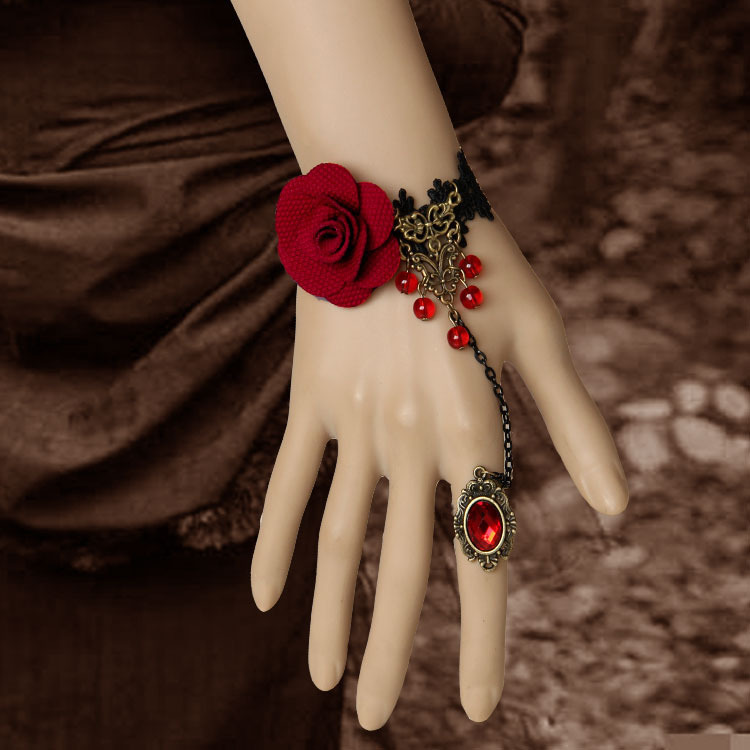
   He then goes on to describe her as a "slave flower", which could also be used to describe his feelings about her because he literally thinks she is beautiful like a flower, but also could be used to describe how because he is her guardian she is also like his personal slave now. In literal terms, I slave flower is a bracelet with a flower
One can see that even this slave flower has a sensual feel to it. 
Humbert makes the connection of how the rules and laws are now compared to the Roman days, which are famous for young prostitution. Roman prostitutes started off as young as 12 years old and carried that profession throughout their lives until they would eventually die of a sickness or old age. Humbert includes the words "casually plucked between business and bath". This could make it seem that it was easy for a pedophile to have sex with a young girl and fit it into their daily schedule, instead of having to go around it like he does now. He wishes that this sort of ancient world were to still exist then the relationship between  a male and a young female would not be considered taboo. He relates that the adult world and child world, which back in this "ancient world" used to coexist together, has now been "severed" by the laws. He believes that these laws only serve as a barrier to stop him from getting what he is interested in: sex. Everything Humbert does and comparisons he makes boils down to the fact that he is interested in a sexual life with her. He is not interested in her feelings about other things or her interests. As he mentions that she was like any other child, he has limited interest in her. He only noticed her when she started sexually maturing and when she told him about her sexual encounters at camp. Much like the slave flower, Lolita is captivated by Humbert's hold because she is so young. If she were to disagree with anything Humbert is doing or has done, she would have limited say. By making this comparison, Humbert shines light to his tone and his overall perception of Lolita. It is important to note that he thinks of her like this slave flower and that he is only upset because he did not realize how innocent she was until she wasn't. 


Final Project Reflection


Text: Lolita Vladimir Nabokov
Critical Lens: Psychoanalytical


By having the opportunity to read Lolita, I was able to learn how to look at text through different text. I learned what to look for when being able to read through the psychoanalytical lens. By reading the novel through this specific lens, I was able to find the how the Humbert was able to view society and what he thought about him being attracted to young girls. If I would have read this novel through a different lens, I would have ended with a different perspective towards Humbert some of the things that I would have missed would be how his actions were viewed by society. By being able to read through the lens that I did, I was able to interpret how the unconscious of the author and Humbert was. In general my beliefs did not change because of this book, I still believe that pedophilia is wrong no matter what kind of history that person had. Through this novel I was able to learn that I stick to my beliefs even though this book was against the theories of Freud.

Critical Lens Close Reading

Text: Lolita Vladimir Nabokov

Critical Lens: Psychoanalytical

Now, squirming and pleading with my own memory, I recall that on this and similar occasions, it was always my habit and method to ignore Lolita’s states of mind while comforting my own base self. When my mother died in a livid wet dress, under the tumbling mist (so I vividly imagined her), had run panting ecstatically up that ridge above Moulinet to be felled there by a thunderbolt, I was but an infant, and in retrospective no yearnings of the accepted kind could I ever graft upon any moment of my youth, no matter how savagely psychotherapists heckled me in my later periods of depression. But I admit that a man of my power of imagination cannot plead personal ignorance of universal emotions. I may have also relied too much on the abnormally chill relations between Charlotte and her daughter...It had become gradually clear to my conventional Lolita during ot singular and bestial cohabitation that even the most miserable of families lives was better than the parody of incest, which in the long run, was the best I could offer the waif.

In this passage the reader is able to see that Humbert Humbert is now realizing that Lolita does not have the same feelings as he does towards her. In this chapter Lolita tears up when she sees an ordinary encounter between her friend and her father. We are able to see that she may hide emotions of wanting to know what it is like to have a real father. Humber also realizes that Lolita is missing her mother. This shows that Humbert can only assume what Lolita is thinking but he never talked to her about her true feelings in her relationship with her step father. She did not even receive a lot of emotional support from anyone when her mother died, which could have affected her current mental state. The author used the characters in this novel in order to show that the the theories of Sigmund Freud can be proven wrong through many situations. He wrote this novel not only to show that the theories were wrong but to also prove a point in the views of love.

Lolita Final Reflection

A summary of Lolita is that there is a man named Humbert. He is very manipulative and selfish. The tragic event of the girl he is talking to dying as a child causes his life to spiral. He mentally stagnates in that immature 13 year old sexual maturity. This causes him to only be attracted to girls of that age which makes him go for a 13 year old girl named Lolita. He does many things in his effort to get her and ends up in a court hearing in which the story takes places. To the court he explains the tragedy and the events that occur with Lolita. He takes blames for what he's done, but explains how he could not control his attraction and how his past made him the way he is. There are many things in the story like how he marries her mom and runs away with her in the story, but the central theme is how his issues have caused him to become who he is. Going into the story I was not expecting much more than a creepy story about a pedophile who falls in love with a girl, but this story showed me a lot of things. It showed me that things are not always black and white or just right and wrong. The book opened me up to remembering that while people have misguided intentions many times it is events in their past that make them who they are. In Humbert's case for example he seemed to be fine until Annabel's death seemed to cause him to snap. Literature-wise this novel taught me to not take everything I see as fact. Until Ms.Richey pointed out that Humbert could have biased intentions when talking to the jury I never thought of it as a factor and took his words as the truth. I learned to pick and choose what I believe and what could be skewed. I was not only able to use this skill not only in the reading of this book, but I will be able to use it to get deeper into my reading and analysis of other novels and written pieces. Additionally I learned that through the psychoanalytical lens I can learn about the author and his intentions like the message he is trying to deliver through the reading. Vice-versa I have learned that by learning about the author and his background and motivations I can see why he did things in the book and what he is trying to say. That why overall I was thankful for reading this novel because it opened my mind up to many viewpoints that I would not have thought of looking at. Additionally I am happy about the lens I chose because it was very interesting to me and I learned new ways to analyze the meanings and themes of a novel.

Responding and Reflecting- #5

Book: Lolita
Lens: Feminist

Growing up, every thing I did or any harm that came my way always seemed to be my fault and I grew up with this mindset. If I fell down the swing, it was my fault for going on it. If I scraped my knee, it was my fault for not watching where I was going. Even in preschool, when I walked in on a boy peeing- it was my fault for not knocking first. If my brother or dad got angry at something I did, it was my fault for aggravating them.  I adjusted to this my fault mindset that I believe a lot of young children are exposed to. Young children grow up hearing lecture after lecture and it is all because the grown-ups know best for them. Especially towards the idea of pleasing men.

I relate this example to the development of Lolita. Truthfully, Lolita is a child whether she wants to admit or whether Humbert want to admit it or not. We see in the book that Humbert is obsessed with micromanagement and having things go his way. In this sense, he focuses on the things Lolita does that he does not enjoy, most of the time it is the childish tendencies she seems to have. It seems as though he loves her childish looks, but does not like her movements, attitude, way of responding, the way she scrunches her nose, and so on. Humbert fantasizes on the idea of them being together, but he also focuses on the fact that she has to do everything he says. In reality, it is Humbert who put these ideas into his head, it is him that expresses his "love" towards Lolita. Not once in the novel does he share his desires towards Lolita with anyone other than Lolita aside from the reader. In one scene,  Humbert starts a "playful" tussle with Lolita causing her to put her legs on his lap to which Humbert rubs himself against her and climaxes apparently without her noticing. After this is over, she stands up and she carries on- obviously having no idea about what had just happened. This again shows us how Humbert has created these things in his head.  He is seeking sexual fulfillment in this scene whereas Lolita is only playing. I believe that by categorizing Lolita as a "different girl-child" and even adding "demoniac" features to her, helps Humbert turn her into something she is not in his head. For this reason, I don't believe that Lolita is to blame or that she "provoked" Humbert which caused him to act this way. Humbert's age and "wisdom" should know better than to chase after a 12 year old. Additionally, when Charlotte, Lolita's mother, passed away he dreads making Lolita his legal daughter. Although in the book  we continuously see him trying to be a father figure and describing himself as someone who cares for her in more of a sexual way. I don't believe that Lolita should have to apologize and have to explain her actions because she was the victim in this necessary. Even later in the book when she urges him to kiss her, she does not know any better as we later see when she continues acting like a child and by her speech. This culture that women should have to please men leads some readers to believe that Lolita is at fault when she egged it on. This is wrong.

Critical Lens Close Reading


Text: Lolita Vladimir Nabokov
Critical Lens: Psychoanalytical

Was she joking? An ominous hysterical note rang through her silly words. Presently, making a sizzling sound with her lips, she started complaining of pains, said she could not sit, said I had torn something inside her. The sweat rolled down my neck, and we almost ran over some little animal or other that was crossing the road with tail erect, and my vile-tempered companion called me an ugly name. When we stopped at the filling station, she scrambled out without a word and was a long time away. Slowly, loving, an elderly friend with a broken nose wiped my windshield-they do it differently at every place, from chamois cloth to soapy brush, this fellow used a pink songe. ((Nabokov 141).

In this chapter of the novel Lolita loses interest in being with Humbert. While he starts being concerned in what Lolita will say to the authorities since she states later before the passage that she was going to call the police and tell them that he raped her. At this point she Lolita seems to start feeling annoyed with Humbert and starts to use him to get money. This not only shows how much Humbert Humbert is in love with her but it also starts to show a different side of Lolita. Since the reader was always shown the thought process of Humbert, the understanding of the type of person Lolita is starting to be shown. But looking back at the beginning of the novel, Humbert did describe how you would have to be an artist and a madman in order to be with a nymphet. We are shown how he is able to accept Lolita even though she acts this way towards him. This brings up one of the many topics that arise from this book, which is if Humbert and Lolita actually love each other or is Humbert unconsciously thinking of Annabel when he is with Lolita. Looking at it using this passage it is safe to say that Humbert could love Lolita because in the beginning of the book we are not told about the interactions of Annabel and Humbert. We only know that they use to be in love but because of her death, Humbert lived his life trying to hold on to her.

Critical Lens Close Reading 2


Text: Lolita Vladimir Nabokov

Critical Lens: Psychoanalytical

Now, my dearest, dearest, mon cher, cher monsieur, you have read this; now you know. So, will you please at once, pack and leave. This is a landlady’s order. I am dismissing a lodger. I am kicking you out. Go! Scram! Departez! I shall be back by dinnertime, if I do eighty both ways and don’t have an accident (but what would it matter?), and I do not wish to find you in this house. Please, please, leave at once, now do not even read this absurd note to the end. Go. Adieu. (Nabokov 67).

The following passage is a continuation of the note that Lolita had written to Humbert when she was on her way to camp. In the note she had written, it stated that she had fallen in love with him and how she was a “lonely woman”. In the note she stated that he was the love of her life. The reaction that Humbert had to was “repulsion and retreat”. He later on explains that his second reaction was like “a friend’s clam hand falling up” on his shoulder “and blinding [him] at the time”. In being able to respond to the letter Humber Humbert was happy that she was able to see him the way she does. But Lolita’s love toward Humbert can be questionable since she states that he had similar traits to an actor that she was also in love with. In the passage we are able to see the type of person in how her vocabulary how she is very debatable in her feelings. She also shows signs of regret in confessing her emotions toward Humbert. But when she states that if he stays she will assume that he likes her as much as she does. She goes on to say that Humbert will be the father of her daughter and in general going deep about her emotions when she talks about the possibility that he would stay with her. It is interesting because later on she is the one that ends up leaving him, while he still has these strong emotions towards her.

Lolita Responding and Reflecting #3

Another character in the novel that can be analyzed is Lolita. She can be analyzed both through how the relationship is effecting her and how Humbert's views and intentions influence how she is portrayed. If you look at her in the beginning of the novel she seems to be very innocent and caring. Through the novel you can notice that she slowly becomes more and more manipulative and selfish. By the end of the novel she becomes very conning and manipulative. This goes in line with how much their relationship progressed so you can see the correlation in how the abuse in their relationship hurt her mentally and caused her to become the manipulative individual that she became. Also through the novel you can see how Humbert's intentions control how she is portrayed. He makes her seem a lot more sophisticated and manipulative than a 12 year old could be. This is expected since he is trying to seem like the victim in front of the court. This is why you cannot take everything he says as fact, but you can see that he portrays her as becoming more and more manipulative as their relationship progresses which is expected and believable since mental disorders are since to be correlated with being abused as a child.

Lolita Critical Lens Expert

The post I read was the psychoanalytical critical lens expert analysis passage for Lolita. It was called "Vladimir Nabakov and Sigmund Freud, or a Particular Problem". Vladimir Nabakov was known to have very negative views towards Sigmund Freud. Freud is known for coming up with the psychoanalytical lens which is the analysis of the views and intentions of the author and main character/narrator of a novel through the reading of the novel. This was shocking because it was one of the first times that a famous author had so much hate for a famous psychologist. Through Humbert he seems to question and talk about many of the ideals that Freud stands by when talking about the psychology of people. For example he talks about the sexual development of Humbert to show that through time people do not always develop and mature sexually as Freud insisted. He is clearly still at the sexual maturity of when he was with Annabel. It is interesting to see how Annabel's death almost stopped him from maturing and stagnated him with the same childish maturity level. Another example of this is how Lolita's mental disorders seem to stem from the abuse dealt to her by Humbert. As there relationships prolongs she becomes more and more manipulative. Through these cases you can see that Humbert is trying to talk about many of Freud's ideals. It is hard to see if he agrees with them or is making fun of them.

Responding and Reflecting

Text: Lolita Vladimir Nabokov
Critical Lens: Psychoanalytical

Through what I have learned in psychology, there are many things that I question in the way that Humbert’s childhood has brought him to where he is now. In one part of the book he explain how he can hardly remember Annabel and how he can recall Lolita very easily. What I question is how can someone so important in his life that has affected him in so many ways, can be forgotten/replaced so easily.
This leads me to think that Humbert is holding on to Annabel through being attracted to nymphets. I the beginning of the book he states that he would hang out in parks so he could be able to watch the nymphets play. In another part of the book we are introduced to Valeria. The audience is told that he decided to marry her, not because he loved her but because of her child-like nature and flirtatious, doll-like airs. But when she confessed that she is having an affair with a taxi driver, he gets really frustrated to the point where he wants to find an opportunity where he can kill her. Even though he never lover her, he was able to become really frustrated towards her when she cheated on him. This brings me back to my point in stating that although Humbert Humbert states that he has forgotten Lolita, from my point of view, he has gotten Annabel's qualities and tried to look for them in other women. Since he found Valeria to be “child-like” he was still unconsciously thinking of Annabel.  

blog post #3: critical lens close reading

Book: Lolita
Lens: Psychoanalytical              
                        "But let us be prim and civilized. Humbert Humbert tried hard to be good. Really and truly, he did. He had the utmost respect for ordinary children, with their purity and vulnerability, and under no circumstances would he have interfered with the innocence of a child, if there was the least risk of a row. But how his heart beat when, among the innocent throng, he espied a demon child, "enfant charmante et fourbe," dim eyes, bright lips, ten years in jail if you only show her you are looking at her. So life went. Humbert was perfectly capable of intercourse with Eve, but it was Lilith he longed for. The bud-stage of breast development appears early (10.7 years) in the sequence of somatic changes accompanying pubescence. And the next maturational item available is the first appearance of pigmented pubic hair (11.2 years). My little cup brims with tiddles."        
                                                                               
The Age of Innocence 
Alfred Drury, R.A., 1856 - 1944

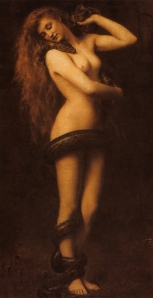
Lilith by John Collier (1892)
                 In the passage above, Humbert explains that he did try to behave as others should, to be responsible enough to not be attracted to young girls as to not take advantage of them. In the passage, he explains that it is not his fault, but the child's responsibility to not attract him in the first place. He states that a demon child, a "enfant charmante et fourbe" ( a charming and deceitful child ) will always catch his eye and that we would never interfere with a child's "pureness". The biblical allusion to Eve and Lilith was quite interesting, assuming any woman his age would be Eve, and Lilith was the young girls he was attracted to. There are many explanations about Lilith's part in the story of Adam and Eve, that she was the original Eve, that she refused to oblige to male dominance and ran off into the red sea. One variation of the Lilith's story that would make sense to compare is that she had "committed adultery with Satan" (source) and turned into a succubus, a demon that seduces men, after refusing to submit Adam. After that, God created Eve as a replacement to satisfy Adam. We know that Humbert thinks very highly of himself, as earlier in the book, he states that he "at the snap his fingers" (15) could have any adult female he wanted. This would be why he referenced himself to Adam, who was given Eve right after he was denied Lilith. What's truly frightening about this allusion is the comparison of the young girls to Lilith. With this comparison, this solidifies his mentality that he is not responsible for his attraction to these young girls that are not "pure" or "innocent", that this is caused because they are as he explicitly states, "demons" or more specifically  "succubi" that seduce him. This mentality is a common one that sexual predators have, that they truly believe their actions are justified because the responsibility is not theirs to not be a sexual predator, that the responsibility falls onto the victim to not be a target.


Thursday, May 14, 2015

Lolita Close Reading #2

“All at once we were madly, clumsily, shamelessly, agonizingly in love with each other; hopelessly, I should add, because that frenzy of mutual possession might have been assuaged only by our actually imbibing and assimilating every particle of each other's soul and flesh; but there we were, unable even to mate as slum children would have so easily found an opportunity to do so.” p.12 This excerpt specifically made me notice a lot of things about Humbert and caused me to ponder how specific events can change a person. His descriptions about the time give me the sense that before Annabel's death he was a very "normal" kid and while there was other struggles going on in his life until that time he had not let it effect him. It seems almost as if her death snapped the last straw. From this point on it seemed as if he lost his compassion for others and became selfish. It can be seen at how he states that he had flings with multiple woman, but never settled and would get with woman like for example Lolita's mom for personal gain I didn't notice this until the end of the novel when he sees Lolita and finally notices completely what he did wrong. While before he did care about her it was not until that point that he truly cared more about her than his personal gain. This can be seen clearly by how he leaves her since he sees that she is happy even though it is not what he wants. So one could say that that event of Anabel's death ended up causing Humbert to become the selfish man that he became.

Critical Lens Expert

Text: Lolita Vladimir Nabokov
Critical Lens: Psychoanalytical


Image result for sigmund freud According to Durantaye in Vladimir Nabokov and Sigmund Freud, or a Particular Problem bring up an interesting point in knowing why the author decided to write a Lolita with the context it has. The article talks about how Nabokov disagreed with the beliefs of Sigmund Freud and how the past of a person affects who they are in the future. He also believes that everything a person does has a deeper meaning that leads to explain who the person is in reality and what is in their in unconscious. This would explain why he chose to give Humber Humbert a perfect-like childhood so that people can see that it does not really matter what you experienced.
Sigmund Freud is known as the father of psychology, since he was the first to say that our dreams play a huge part in revealing what goes on in our unconscious. He was also able to say that our conscious is only a fraction of our thought process. He introduce the ego,id and super ego. With Sigmund’s theories in mind as well as how much of a controversy he caused in the field of psychology, Nabokov was one of the many people that disagreed with his theory’s. Asa result, Nabokov was able to create this novel in order to prove that not all of Freud’s theories are true. The article states how Nabokov was able to interpret the ideas of Freud and how we was able to put them to test through pieces of art.

blog post #2 : critcal lens close reading

Book: Lolita
Lens: Psychoanalytical
                       "At other times I would tell myself that it was all a question of attitude, that there was really nothing wrong in being moved to distraction by girl-children. Let me remind my reader that in England, with the passage of the Children and Young Person Act in 1933, the term "girl-child" is defined as "a girl who is over eight but under fourteen years" (after that, from fourteen to seventeen, the statutory definition is "young person"). In Massachusetts, U.S., on the other hand, a "wayward child" is, technically, one "between seven and seventeen years of age" (who, moreover, habitually associates with viciousor immoral persons). Hugh Broughton, a writer of controversy in the reign of James the First, has proved that Rahab was a harlot at ten years of age. This is all very interesting, and I daresay you see me already frothing at the mouth in a fit; but no, I am not; I am just winking happy thoughts into a little tiddle cup. Here are some more pictures. Here is Virgil who could the nymphet sing in a single tone, but probably preferred a lad's perineum. Here are two of King Akhnaten's and Queen Nefertiti's pre-nubile Nile daughters (that royal couple had a litter of six), wearing nothing but many necklaces of bright beads, relaxed on cushions, intact after three thousand years, with their soft brown puppybodies, cropped hair and long ebony eyes. Here are some brides of ten compelled to seat themselves on the fascinum, the virile ivory in the temples of classical scholarship. Marriage and cohabitation before the age of puberty are still not uncommon in certain East Indian provinces. Lepcha old men of eighty copulate with girls of eight, and nobody minds. After all, Dante fell madly in love with Beatrice when she was nine, a sparkling girleen, painted and lovely, and bejeweled, in a crimson frock, and this was in 1274, in Florence, at a private feast in the merry month of May. And when Petrarch fell madly in love with his Laureen, she was a fair-haired nymphet of twelve running in the wind, in the pollen and dust, a flower in flight, in the beautiful plain as descried from the hills of Vaucluse. "
                                                                                                                                                                   

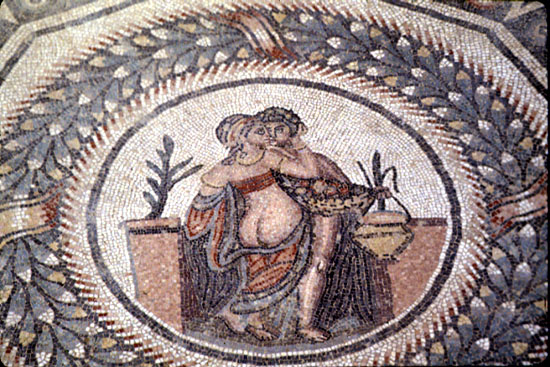
                                                                                                  Image by Stephanie Sinclair, 2005

In this passage, Humbert explores the legality of the ages of young girls. He points out that the age pools of young girls is muddled due to one definition of young girls being over eight yet under fourteen, and the other definition being "between seven and seventeen". It's interesting that Humbert chose to include both these definitions but can be explained why he did when thinking of the morality of the situation. When thinking of a relationship between an adult male and an underage female, how are we to judge what ages deems the relationship immoral when the ages of young females are pooled into such large gaps? What deems a relationship of an adult man with a seventeen year old girl more acceptable than a relationship of a man with a twelve year old girl. Obviously both situations are not alright yet Humbert chose to include these different words that defines a young girl to the audience, or the jury, to invoke these questions, for them to challenge their own morality before his and to question, how are we to judge what is okay and what is not. He explains that the girls described with these ages are not uncommon to be found in situations such as child marriages or acting as what he calls "nymphets", which means an attractive and sexually mature young girl. He uses these situations as sort of an excuse, "if these other men were attracted to 'girl children' then why is it wrong for me to feel similarly?"
 

         What might or not might be a fault in his explanation is when he mentions Dante falling in love with Beatrice as she was nine in May. Assuming he is speaking of Dante and Beatrice Portinari, Dante had in fact met and fallen in love with Beatrice when she was nine, but he was only a year older than her at the time. The age dynamic is completely different because in this situation, the attraction is between two children, not
a child and an adult.
                  This might not be going to far from the point in his defense, however, because looking deeper into this reference of Dante and Beatrice, it can be compared to the love between Annabelle and Humbert. Dante fell in love with Beatrice at first sight and stayed in love with her even after taking the hand of another man in marriage. Beatrice had passed away four years after her marriage, yet Dante had still been fixated on her and dedicated many of his works in her memory. This is similar to Humbert falling in love with a young girl as he was young, yet when she passed became fixated on young girls years and years after, possibly because her memory lives on in other young girls. 

Critical Lens Close Reading

Text: Lolita by Vladmir Nabokov
Critical Lens: Psychoanalytical
You have to be an artist and a madman, a creature of infinite melancholy, with a bubble of  hot poison in your loins and a super-voluptuous flame permanently aglow in your subtle (oh, how you have to cringe and hide!), in order to discern at once, by ineffable signs-the slightly feline outline of a cheekbone, the slenderness of a downy limb, and other indices which despair and shame tears of tenderness forbid me to tabulate-the little deadly demon among the wholesome children; she stands unrecognized by them and unconscious herself of her fantastic power. (Nabokov 17).
In the beginning of the novel Humbert states that before Lolita there was Annabel, and how in his younger years they would be in love but were not able to consummate their love since she died four months later. In this passage we are able to see that he accepts who he is in being attracted to nymphets and describes the type he is. In the following the passage he describes that nymphets are generally girls who are ages 9 to 14. But he also states that not all of the girls are nymphets.  He goes on stating that you have to be an artist, a mad man and so on. He acknowledges that he is different in the way that he is able to view young girls. But does not see the correlation between the way he sees nymphets and the way he saw Annabel. We are only told about the relationship between Annabel to Lolita.

You can tell that the author carefully chose his words in being able to describe who Humber Humbert was. By using phrases like “bubble of hot poison in your loins” and “little deadly demon” we are able to notice that the author wanted to make sure that the reader had an idea of the thought process of Humber Humbert. The author’s choice of words, like “hot poison in your loins” and other similar language in other passages could can been because of his great use of assassination as a theme that has been really common in his other written novels. Later in the novel he states that had reincarnated Annabel in Lolita. Meaning that he is trying to hold on to Annabel through Lolita.

Wednesday, May 13, 2015

Lolita Responding and Reflecting #2

Looking specifically at the psychoanalytical lens has opened my eyes to look for many more things when reading. When I first started reading Lolita I took everything Humbert stated as fact, but through Ms.Richey's explanations and more own reading I learned to look at the viewpoint of who is talking in each situation. Doing this completely changed how I saw the story. By looking into how Humbert's personal views and intentions change how he described the story you become a lot more critical and have to guess for yourself exactly what happened and what Humbert has created in his mind or is just saying to please the jury. It is also interesting to look at what the story says about the author and what he is trying to show through the novel. I believe that he is not approving of Humbert's actions, but he is using Humbert's experience to make claims about love and society. I believe that by showing how Humbert is not purposefully trying to hurt Lolita he is showing that society must remember to look at things holistically instead of just as black and white. Even though his actions were selfish Humbert is not a bad person and critics of his actions must remember that he is acting based on what he thinks is okay by following his passion and his intentions are not as evil as other viewers seem to view it as.

Tuesday, May 12, 2015

Lolita Close Reading

“Lolita, light of my life, fire of my loins. My sin, my soul. Lo-lee-ta: the tip of the tongue taking a trip of three steps down the palate to tap, at three, on the teeth. Lo. Lee. Ta. She was Lo, plain Lo, in the morning, standing four feet ten in one sock. She was Lola in slacks. She was Dolly at school. She was Dolores on the dotted line. But in my arms she was always Lolita. Did she have a precursor? She did, indeed she did. In point of fact, there might have been no Lolita at all had I not loved, one summer, an initial girl-child. In a princedom by the sea. Oh when? About as many years before Lolita was born as my age was that summer. You can always count on a murderer for a fancy prose style. Ladies and gentlemen of the jury, exhibit number one is what the seraphs, the misinformed, simple, noble-winged seraphs, envied. Look at this tangle of thorns.” p.1 This quote from Humbert in the beginning of the novel shows a lot of things about his viewpoint. First of all you can tell by how he describes Lolita that while it is messed up how he thinks of her since she is so young he clearly does not have ill will towards her and his actions later in the novel are misguided, but not evil. This is clearly since in the points where he describes Lolita you can tell that he has genuine attraction to her. The author brilliantly has Humbert describe very specific about Lolita like her height and all of her names which is the type of things you would expect someone who is truly infatuated with another to say. You can see where he states, "there might have been no Lolita at all had I not loved, one summer, an initial girl-child" that he believes it was his past and the scars from it that attract him to adolescent females. I am not trying to justify or question his actions one way or another, but it is interesting to see how he thinks throughout the story because of his very unusual perspective.

Wednesday, May 6, 2015

Responding and Reflecting #4

Book: Lolita
Lens: Feminist


I think that in this book the "love" that Humbert has for Lolita is present when he marries her mother, Charlotte Haze, in fear of losing Lolita. One of the worst parts is the way he speaks about Ms. Haze even though she is only wrapped around the idea that they're in love.

Humbert thinks that he is extremely attractive. He believes that the reason Charlotte fell for with him and the reason that Lolita is in love with him is due to these good-looks. He tries to excuse his behavior by saying like hey I'm good-looking and I could get with anyone I want so it's not wrong that I want these young girl because it's not creepy. He intends that it is only unacceptable for unattractive men or men who are not as educated as him to try and get with girls of that age group. He makes it seem like Lolita likes him and falls for him because he is good-looking, but that would not be the case if he wasn't. I think this ties back to a rape culture attitude based on how people perceive these situations. In many cases, people fight back as saying like " I get tons of girls/guys. I don't need to rape anyone to get what I want". I feel like the role of women in our society make it okay for people to get away with this sometimes. Humbert's views towards women allow him to maintain this mindset because he has minimal respect towards them. He feels he's doing them a favor with his presence. He also gives the idea that Lolita is "unrapeable" because of her sexual tendencies. So far I have read that Lolita has grown fond of Humbert, this he may say gives him the right to advance sexually with Lolita. 
As I read on, I continue to see how Humbert's attitude about himself and towards women influence his actions and he continues to make excuses for his actions. The point is that he is raping this girl even if Lolita is fond of him or she does love him. This relationship was not started with both parties going in with the intention of a romantic relationship or even an understanding of their relationship. In reality, it is more like Humbert trying to get what he wants with this girl and going through great lengths to achieve it.  

Tuesday, May 5, 2015

Psychoanalytical Lens


When first choosing to read Lolita by Vladimir Nabokov, I questioned why the main character does what he does like begin in a relationship with a minor. What caused him to be that way and why? How has his surroundings or the environment he grew up to be in affect his mentality which has lead him to where he is now. With these questions in mind I chose to read from a psychoanalytical lens in order to figure out his thought process. By reading what is on the back of the book, there seems to be many different emotions towards the book some controversial others see it as heartbreaking. I wanted to figure out not only the characters though process but as well as the authors purpose of deciding to write a controversial book. By reading through the psychoanalytical lens, I will be able to see how the author's and Humbert's unconscious affects their conscious state.

Critical Lens Close Reading #3

Book: Lolita
Lens: Feminist Lens


                          "Now I wish to introduce the following idea. Between the age limits of nine and fourteen there occur maidens who, to certain bewitched travelers, twice or many times older than they, reveal their true nature which is not human, but nymphic (that is, demoniac) ; and these chosen creatures I propose to designate as "nymphets". 
        It will be marked that I substitute time terms for spatial ones. In fact, I would have the reader see "nine" and "fourteen" as the boundaries-the mirrory beaches and rosy rocks- of an enchanted island haunted by those nymphets of mine and surrounded by a vast, misty sea. Between those age limits, are all girl-children nymphets? Of course not. Otherwise, we who are in the know, we lone voyagers, we nympholets, would have gone insane. Neither are good looks any criterion; and vulgarity, or at least what a given community terms so, does not necessarily impair shifty, soul-shattering, insidious charm that separates the nymphet from such coeval if hers as are incomparably more dependent on the spatial world on synchronous phenomena than on the intangible island of entrances time where Lolita plays with her likes.  Within the same age limits the number of true nymphets is strikingly inferior to that of provisionally plain, or just nice, or "cute" or even "sweet" and "attractive" ordinary, plumpish, formless, cold-skinned, essentially human little girls, with tummies and pigtails, who may or may not turn into adults of great beauty... the little deadly demon among the wholesome children; she stands unrecognized by them and unconscious herself of fantastic power." 
(nymph) 

         In this passage, he begins to explain the type of girls he is attracted to. From the get-go he describes the girls he is attracted to as nymphets, but he also includes words such as demoniac to describe Lolita. He says that these nympholets or girls that he attracted to have something special about them that intrigue him to like them.   He sees Lolita as a possession and he sees her as sort of a mythical creature instead of the under-aged girl that he should be seeing her as. He is more than twice her age and he does not seem to capture this idea. He uses words as "chosen creatures" to describe the girls that he has been raping.
       In any normal situation, a man does not describe his lover or any significant other as creatures who are "chosen", right off the bat we can tell that this is possessive behavior which translates back to who he is and his beliefs. We can connect this back to the fact that he has no respect for females of any kind and continues to use them for his own benefit. In this passage, he also makes it very clear that he has a limit of 9 to 14 more or less making it his "type" and they are no longer attractive to him or again "his chosen creature" if the age does not meet this requirement.
     By depicting these young girls as nymphets with demoniac features, he gives a sort of excuse of how it is acceptable. His intention is to try to steer away from the fact that they are only girls who are 9 to 14 years old and he tries to play it as like they are a young age, but then again there is something different about them. However, he is just fabricating this difference in his head. These girls do not have any mystic features or powers, but in reality are just young, pubescent girls .
     In this passage, Humbert speaks with a lot of imagery and very whimsical. He makes the writing sound very pretty, when trying to describe the young girl he encounters. To describe the age limits that he prefers, he compares it to beaches and rocks that border an enchanted island "haunted by those nymphets of mine". He uses the comparison of beaches and rocks to capture the idea that inside of these boundaries lie wondrous things, much like a castle of sorts. He uses the words "vast, misty sea" to describe the uncertainty when searching for one of his "nymphets".  Because he describes that not all girl-children are nymphets, it is important to keep in mind that these boundaries and similes are almost real to him. These are the things pictured in his head to succeed towards finding a nymphet.
     Lastly, he ends this off with distinguishing differences between "human little girls" and his nymphets. He says that even in the pool of children from these age limits the number of nymphets does not meet his liking he describes the number as "inferior". Humbert says that human girls are ordinary, but that nymphets carry a fantastic power. Although, in a normal person's eye they would all look like young girls, Humbert knows how to tell this difference which then leads him to develop this attraction. He genuinely believes that there is a difference between human girls and nymphets and he thinks it's unique that he is able to capture that. He seems almost repulsed by the idea of being with this regular human little girl because being with an nymphet is a totally different story. All in all, these are all young girls and he is fabricating these comparisons and differences in his mind to excuse his pedophilic behavior.

👓 choosing my lens 👓


                 I decided to use the psychoanalytical lens while reading Lolita in order to analyze the thoughts and motives behind Humbert Humbert. Previous experience with this lens could include many of the other projects that were done in AP English Literature class when analyzing other characters motives, more specifically in the Drama Interpretation project, when my group questioned the sociopathic behavior of Iago in Othello. My personal beliefs when it comes to analyzing characters is that everyone will think they're not a bad person. Everyone will have their reasons behind their actions and believe those reasons justify those actions, which is why they do them. Another lens I considered was the Modernism lens, because the I wanted to analyze his actions from society's take on the limitations of love and how history and different cultures affected the normality of relationships with a big age gap.  What I am hoping to get out of this project is learning how to analyze characters from an unbiased point of view.
                                                                                                                     - norma 

Saturday, May 2, 2015

Lolita Responding and Reflecting

Prathik Vemulapalli

Responding and Reflecting

Lolita has opened my mind to many new ideas and has caused me too question my own beliefs in many ways. While I will never believe Humbert's decisions were right I now understand where he is coming from and that the situation itself cannot be painted in black and white or right and wrong. For example while many would say right off that Humbert is a bad person it seems that it was more of his mental issues that caused this as opposed to his character. Humbert states at one point, I looked and looked at her, and I knew, as clearly as I know that I will die, that I loved her more than anything I had ever seen or imagined on earth. She was only the dead-leaf echo of the nymphet from long ago - but I loved her, this Lolita, pale and polluted and big with another man's child. She could fade and wither - I didn't care. I would still go mad with tenderness at the mere sight of her face.” This quote shows that while his judgement was wrong and he should be held accountable for what he did his intentions were genuine, but selfish. Obviously his actions were wrong and hurt her, but the book showed me situations like this have to be looked at more deeply than just saying he was wrong since it seemed like his childhood trauma almost caused him to not mature mentally in some ways. In the end I still agree with how society is so extremely against this because it can scar the children for their whole lives, but in certain situations like this we must look at everything before making judgments. A moral I learned from this story was that you need to get rid of your personal biases and deeply analyze a situation before making a decision no matter how obvious the answer seems.  

Monday, April 20, 2015

Responding and Reflecting Blog Post #2

Book: Lolita
Lens: Feminist Lens


          Reading from the Feminist Lens is interesting because the book is written from Humbert's point of view. However, as I have continued to read I noticed that many of the female characters are not fleshed out or given much background in this book. Although the purpose of the book seems to shine light on the reality of pedophilia, the other "of-age" female characters in the book are not given a back story or insight to their thoughts and feelings beyond their initial introductions or brief interactions.
         Off the bat, I noted Humbert's views towards women as he begins telling his story. In the beginning he quotes, " I was, and still am, despite mes malheurs, an exceptionally handsome male... I could attain any adult female I chose" (25).  Humbert views these women are possessions and later describes his attraction to young girls as a "dangerous desire". By describing his illegal attraction for young girls as a "desire", in a way romanticizes and attempts to excuse his pedophilic behavior. He refers to these girls and women as things and does not really pay attention to their feelings in his actions. It also connects back to his lack of for these females.    Before Lolita is mentioned and he is speaking about Annabel. he mentions his relationships with her as a child. but then abruptly also mentions that she died from a sickness. The reason I bring this up is because I found it disturbing that he went into detail about their encounters and the way he felt about her, but then when she died he did not mention how he felt about it or how she died. She had just died and that was the end of that. Although she was the one who left, he also kind of "threw her away" and went about it like he could have easily found some else to replace her.
     When I was reading through this novel, I could relate it back to an Law & Order: SVU episode I saw once about a guy who was locked away in jail for many years after his 15-year old's GF's parents reported him to the police for being a sex offender. At the time of the incident, he was 18 and she was 15 but because he was locked away for so long he kept the image of her when she looked 15 in her head and when he got out of jail he looked for 15 year old girls who looked like her so he could kidnap them and have sex with them because his once 15 year old GF was now old when he got out jail. He did not want that. In both of these scenarios, the pedophiles had no thought for the child's life before their actions. They only look to fulfill their selfish needs and treat these women like possessions.

- Grecia


Why I Chose the Psychoanalytical Lens

Prathik Vemulapalli

Why I Chose the Psychoanalytical Lens

A. I thought the psychoanalytical lens would be particularly interesting for a variety of reasons. The main reason this topic interested me is that it is looking at the author instead of the writing or time. By looking at the author instead of just looking at obvious interpretations I believe that their are things we can see that the other him or herself might not even see. From my personal experience I have noticed that when me or others write we subconsciously let our personal opinions show even when we are trying to be honest. I wanted to see if the same could be said for the views of an author based on what he or she is writing. 

D. Another lens I was thinking of doing was the New Historicism lens. This is because while I personally believe writing is not as slanted as some believe I could see how the higher class would have more of an imprint on literature and it would be interesting to see if that effect could be seen in literature of past times and if it really was as biased as some see it to be.

WHY I CHOSE THIS LENS?

Hello readers,

    I chose to do the Feminist lens because it took an interesting perspective to a book that was about child abuse, regarding a female child. I believe that the author's intentions for writing this book would have been somewhat influenced by their views on women and gender roles. Keeping in mind, that the interactions in this book are typically an older male and a young girl, we can ask ourselves : Would the situation be different if the interaction was between an older female and a young boy? Considering the roles of females at the time this book was made or even now that people are reading, is an important element in interpreting the text. In addition, since the entire text is through the perspective of a male, it would be interesting to see how this character and how the author writes this male's view on female roles. Overall, I am excited to read the book and see what feminist take I can approach as I go and analyze each portion of the text.

- Grecia